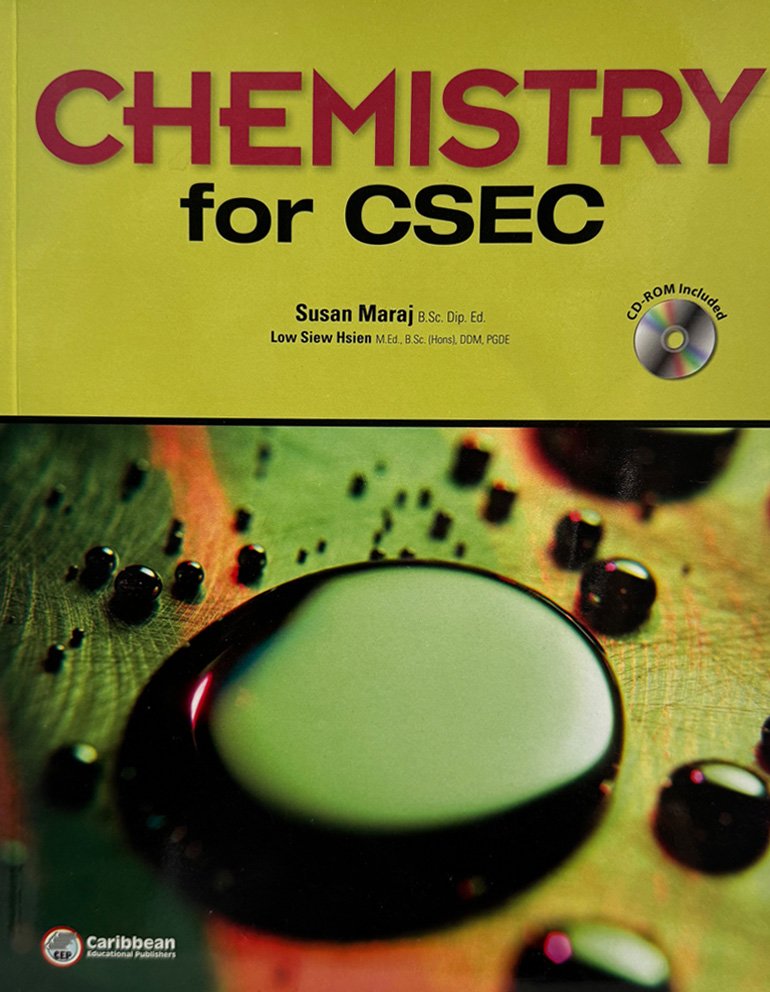
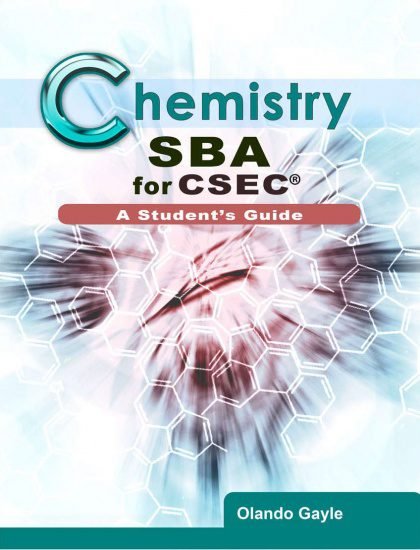

Chemistry SBA for CSEC??- A Student’s Guide?helps Chemistry students to properly and confidently execute their SBAs in an organized and efficient manner, so that they can achieve a good score in this area going into the CSEC Chemistry examinations. Also, since lab books become the property of CXC, students will have the notes they make in this book when revising for the examination. Section A?looks at how to?design a lab project, the investigative project?and?the types of skills to be covered and assessed. This section also gives?explanations?of the types of skills being assessed in CSEC Chemistry. Section B?contains the practical exercises or experiments for the SBA. The experiments cover every topic of the CSEC Chemistry syllabus. Section C?addresses three traditionally difficult areas of the subject, i.e. mole concept, calculations involved in electrolysis and the identification of ions. Scroll down to the Notes to the Students section to download free additional resources. Key Features: Starts with an introductory section containing notes on the School Based Assessment process suggested formats for the SBA skills to be covered in the SBA Includes space for recording the results of experiments, as well as observations, and space for drawing diagrams of apparatus. When the students have submitted their lab books, they will have their own notes/documentation of what happened in the experiments. Incorporates proposed mark schemes for experiments – with these, students can know what they are being marked/assessed for. The student therefore, should be able to ensure that they cover the requirements in order to score the maximum marks on the practical activity/exercise. It should be noted that the teacher has the flexibility to change these mark schemes, that is why they are referred to as “Proposed”. Provides in Section C, major help on three traditionally challenging areas for students: the mole concept calculations involved in electrolysis and the identification of ions Gives tips on how to succeed in Chemistry to students Includes an index – which helps students to quickly locate material on various topics.
| Brands | |
|---|---|
| Color | |
| Special Filters |
| Power Input | 100 – 240V ̴ 50/60 Hz |
| Signal-to-Noise Ratio | > 80dB |
| Output power (W) | 100W RMS (IEC60268) |
| Dynamic frequency response range (Hz) | 40Hz – 20kHz (-6dB) |
| Frequency Response | 40Hz – 20kHz (-6dB) |
| Transducer | 1 x 5.25 inch (135mm) woofers, 2 x 1 inch (25mm) Dome tweeters |
| Dimensions (Width x Height x Depth) (cm) | 32.0 x 33.9 x 26.3 |
| Dimensions (Width x Height x Depth) (in) | 12.58 x 13.33 x 10.35 |
| Weight (kgs) | 6.4 |
| Weight (lbs) | 14.11 |
| Aux-In | 370 mV RMS (3.5mm connector) |
| Mic-In | 20 mV RMS |
| Guitar-In | 100 mV RMS |
| Bluetooth Input (dBFS) | -9 |
| USB Input (dBFS) | -9 |
| USB Format | FAT16, FAT32 |
| Bluetooth Profile | A2DP V1.4, AVRCP V1.6(SW), TMAP1.0, PBP1.0 |
| Bluetooth Transmitter Frequency Range (GHz) | 2.402GHZ~2.480 |
| Bluetooth Transmitter Modulation | GFSK, π/4 DQPSK, 8DPSK ,BLE1M, BLE2M |
| Bluetooth Transmitter Power | ≤ 16 dBm (EIRP) |
| Bluetooth version | 5.4 |
| Charging time (hours from empty) | < 3.5 |
| Cabel Type | AC power cable (type varies by regions) |
| Cable Length (ft) | 6.6 |
| Cable Length (m) | 2 |
| Battery Type | JBL Battery 200, Li-ion Battery(7.4V/4722mah) |
| Battery Charge Time (hours) | 3.5 |
| Maximum music playing time (hrs) | 15 |
Popular essentials for your audio device